Who's who in nature markets
The three groups of people who make nature markets work — sellers, buyers, and capital investors — and how they fit together.
Nature markets are the arrangements through which the environmental benefits of restoring land — cleaner water, stored carbon, richer biodiversity — can be counted, verified, and paid for. Three groups of people make these markets work.
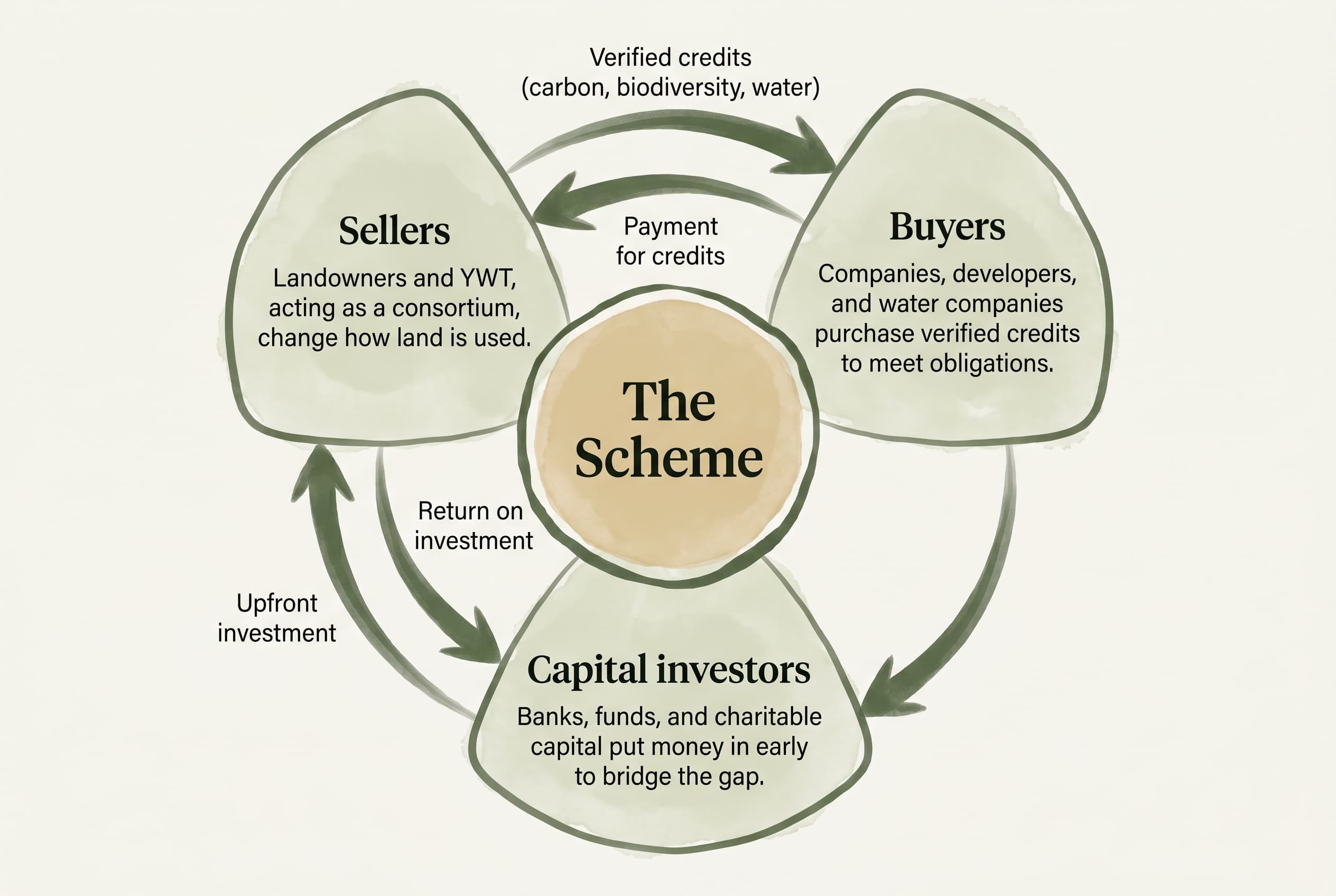
Sellers
Sellers are the people who generate environmental benefits by changing how land is used. They might plant trees, restore peat, slow water down in a catchment, or let grassland return to a richer state.
In Ure Dales, the sellers are the eighteen landowners and Yorkshire Wildlife Trust, acting together as a consortium. They share the work of delivering the changes on the ground and the income that comes from selling the environmental units those changes produce.
Buyers
Buyers purchase credits — verified units of environmental benefit — to meet obligations they carry.
Some obligations are statutory. Housing developers in England, for example, must meet Biodiversity Net Gain requirements under the Environment Act 2021, and can do so by buying biodiversity units from registered habitat banks or landscape-scale schemes.
Other obligations come from corporate commitments. Companies report under ESG frameworks on their environmental impact, and increasingly include purchases of nature-based credits as part of that reporting.
Some buyers are regulated. Water companies, for instance, meet outcomes-based targets set by Ofwat by investing in upstream restoration that improves water quality or reduces flood risk downstream.
Capital investors
Restoring land takes money now. The income from selling credits arrives later. Capital investors put money in early to bridge that gap.
They are often banks, impact investment funds, pension funds with nature-aligned mandates, or sources of charitable capital. They expect a return — either as interest on a loan, or as a share of the credits produced once they are verified.
Capital investors sit behind the sellers in the arrangement. The sellers are the ones doing the work on the land. The capital investors are the ones making sure the work can start before the buyers’ cheques arrive.
How the three fit together
A simple version: sellers do the work, buyers pay for the outcomes, and capital investors bridge the timing gap between the two.
A more careful version: the arrangements can be elaborate. A single scheme might have multiple buyers for different kinds of credits (biodiversity here, carbon there, water quality elsewhere), multiple sources of capital with different return expectations, and complicated contracts specifying who gets paid in what order if things go well — or badly.
The Blended Finance Plan is where the consortium will set out, in detail, which buyers and capital investors it expects to work with, and on what terms.